


































OUTSIDE THE CAMP
A Journey Beyond Religious Christianity
A mini-book created to help those brethren in the present exodus
from the religious systems of men.
Jose L. Bosque
www. GodsLeader. com
Copyright © 2026 Jose L. Bosque
All rights reserved.
This book expresses the author’s present understanding and ongoing journey with Christ. It is not presented as a final doctrinal statement, and readers are encouraged to examine the ideas presented prayerfully and thoughtfully and if need be go outside the camp to find Christ.
Published independently.
GodsLeader. com
Outside the Camp a Mini-Book created to help those brethren in the present exodus from the religious systems of men.
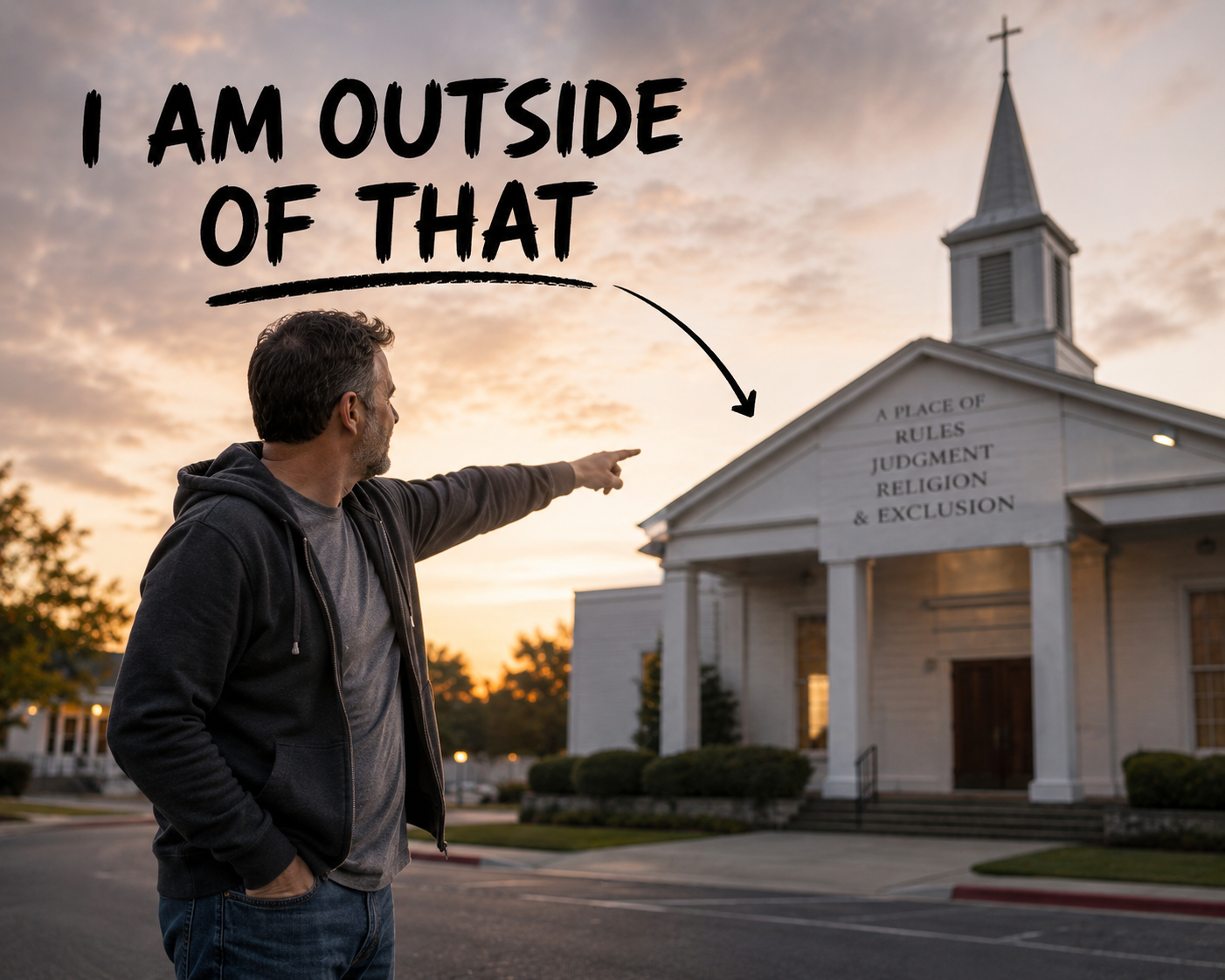
I Didn’t Leave the Church—I Left the Religious System, I am now outside the Camp!
The older I get, the more clearly I see the workings of the Religious System and the fruit it produces. And as I look back over the years, I often find myself saying, “I am outside the camp.”
When I first entered ministry nearly forty years ago, I had no idea that truly following Christ in this generation would eventually place me in a position where I would become a reproach to much of what is commonly called “the church” today.
Please understand me when I say this: I love the Church. I love the real Church, the Body of Christ, and I even love the people who have become deeply embedded in religious systems. I don’t say this from bitterness or resentment. I love people—all people, every race, every culture, every nation, and every background.
The Lord has taught me that love cannot be limited by the boundaries we so often create. The more I have come to know Him, the more I have learned to love His creation.
After traveling to more than eighty nations of the world, I have seen firsthand the incredible beauty found in human diversity. Different cultures, languages, traditions, personalities, and perspectives can reveal something beautiful about the creativity of God.
One would think that the Church would be the greatest expression of that beautiful diversity. Sadly, that is often not the case.
Because of religious spirits, Sunday morning can still be one of the most segregated times of the week—not only racially, but politically, financially, doctrinally, culturally, and even nationally.
Yet Jesus calls us to something far greater.
He calls us beyond the walls and boundaries we have constructed. He calls us to move outside the camp, beyond the divisions created by religion, so that we can truly walk with Him in the midst of a dark and broken world.
Scripture says:
“Therefore let us go forth to Him, outside the camp, bearing His reproach.”
That word reproach carries the idea of being defamed, taunted, rejected, betrayed, or disrespected. And there is a great deal more that could be said about what it means to live outside the camp.
But I can tell you from experience: it doesn’t feel good to the flesh.
It is one thing to say that you are willing to suffer for Christ. It is another thing to actually experience rejection, misunderstanding, misrepresentation, and betrayal from people you once respected and trusted. Everyone likes to fit in and be accepted but if you truly follow Christ today its going to cost you.
The courage and the fortitude only comes when you finally understand that the reproach you carry is not your own—it is His.
Paul expressed this reality when he wrote:
“I now rejoice in my sufferings for you, and fill up in my flesh what is lacking in the afflictions of Christ, for the sake of His body, which is the church.”
By His grace, I have been learning to live those words since I left the Religious System in 2009.
In the early years of my ministry, I lived far too much for the approval of men. I wanted to be accepted. I wanted to be respected. I wanted to be affirmed by the people I respected.
I had no idea that genuinely following Christ would eventually bring backlash from some of the very people whose approval once meant so much to me.
Today, being misquoted, misunderstood, criticized, and judged has become part of my daily journey. Those who truly know me have little doubt that the Lord has me swimming upstream and against the majority.
And honestly, there are days when I would rather just disappear and leave them with their mess.
Sometimes I think about going somewhere quiet, becoming a monk, and simply waiting for Father to take me home. Reproach in any form is not enjoyable—especially as you grow older and begin to value peace more than recognition.
But then I remember something even greater:
He still loves His Church.
And then that love for His Church begins to rise up inside of me, I simply can’t walk away from His people.
The people of the Way have, in many ways, lost their way. Yet I still believe there is hope. I still believe God is at work. I still believe He is calling His people back to the simplicity of Christ, back to love, back to real relationships, and back to the original foundation of the Good News.
So what you are about to read is not intended to be ammunition for another theological debate.
It is something much more personal.
It is a declaration of the mile marker I have just passed in my journey with Christ.
I am not writing this because I believe I have arrived or because I have everything figured out. I am writing because after forty years of ministry, I can no longer remain silent about what I have seen, what I have experienced, and what I believe the Lord has been teaching me.
So when I say:
“I am outside the camp,”
I want to be absolutely clear about what I mean:
I have not left Christ.
I have not abandoned His Church.
I have not stopped loving His people.
I have stepped outside the Religious System—the modern system that has, in many places, come to misrepresent itself as the Church.
And from outside the camp, I am learning to see the Church—and the One who gave His life for her—with new eyes. Here are some things that the Lord has revealed to me, and have been confirmed by the Holy Spirit to others, that are present day hindrances to returning to the WAY.
1. Our Gatherings have become Spectator Services
The American church service may be one of the greatest religious substitutes ever created.
It looks like what we were taught was Church. It sounds like Church. It feels like Church. It has the songs, the sermon, the Bible, the offering, the pulpit, the platform, the pastor, the altar call, the announcements, and the closing prayer.
And yet we have to ask the question many are afraid to ask:
Is this actually the Church Jesus intended—or have we simply become experts at doing something we call “church”?
We have taken something that was supposed to be a living, functioning Body and turned it into a weekly religious event.
People arrive. They sit. They watch. They listen. They sing. They give. They leave. Then they do it all over again the following week.
And we call this “being the Church.”
It is entirely possible that one of the greatest achievements of modern Christianity has been teaching millions of people how to attend church without ever learning how to be the Church.
We have created a religious environment where the majority of people have only one responsibility:
Show up and consume. The professional sings. The professional plays. The professional preaches. The professional leads. The professional prays. The professional ministers.
And the congregation watches…..
We call them “the Body,” but we have reduced most of the Body to an audience. That isn’t participation. That’s spectatorship. And then we wonder why so many believers remain spiritually immature after sitting in church for twenty, thirty, or forty years. Perhaps they aren’t immature because they haven’t heard enough sermons. Perhaps they are immature because they have been trained to watch instead of participate.
The Platform Has Become the Center of Attention
We have built our gatherings around a platform. Everything points toward it. The chairs face it. The lights illuminate it. The sound system amplifies it. The screens display it. The congregation watches it. The sermon comes from it. The music comes from it. The attention goes to it. And eventually the platform becomes the center of everything.
The problem is that Jesus is supposed to be the center—not the platform.
We have created an environment where one person stands above the congregation and everyone else looks toward that person. Then we wonder why celebrity pastors, celebrity worship leaders, celebrity ministries, and religious personalities have become such a powerful part of modern Christianity.
The architecture can preach a sermon before the preacher ever opens his mouth. It says: “Here are the important people.” “Here are the people who minister.” “Here are the people who know.” “And here are the people who sit quietly and receive.”
We may call it leadership. We may call it order. We may call it excellence. But sometimes it is simply religious hierarchy dressed up in Christian language.
We Have made Spectators out of the Body
Somewhere along the way we decided that ministry belongs primarily to the professionals. The pastor ministers. The worship leader ministers. The youth pastor ministers. The missionary ministers. The evangelist ministers.
The congregation supports the ministry. Pay for the ministry. Attends the ministry. Promotes the ministry. And occasionally volunteers to help the ministry.
But the New Testament picture is not a handful of professionals doing ministry while everyone else watches.
The Body is supposed to function. Every member matters. Every member has a place. Every member has something to contribute. Every member is being formed into Christ. We have professionalized what was supposed to be participatory.
And then we wonder why people sit in the pew for years wondering:
“What is my ministry?”
Perhaps the answer is simple:
You were never supposed to hire someone to do what Christ called His Body to do.
The Sunday Attendance Trap
We have also created an obsession with attendance. How many came Sunday? How many joined? How many were baptized? How many seats were filled? How many watched online? How many gave? How many responded?
Numbers become the scoreboard. Attendance becomes the evidence of success. But Jesus never commanded us to build crowds. He commanded us to make disciples.
There is a massive difference.
You can fill a building and still have spiritually immature people. You can have thousands attending every week and very little genuine relationship among them. You can have a packed auditorium and a starving Body. Crowds are easy to gather. Disciples are much harder to form.
The modern church has often become obsessed with getting people into the building while paying far less attention to whether those people are actually learning to live like Jesus.
And here is the uncomfortable truth:
A person can attend church every Sunday for thirty years and still not know how to love their brother. They can know every worship song and still harbor bitterness. They can hear thousands of sermons and still be controlled by pride. They can carry a Bible under their arm and treat people terribly. They can tithe faithfully and remain selfish. They can volunteer every Sunday and never learn how to lay down their life for another human being. So what exactly are we measuring?
The Entertainment Problem
And then there is the elephant in the room:
We have turned many church services into nothing more than religious entertainment. We want excellent music. Excellent lighting. Excellent sound. Excellent graphics. Excellent presentations. Excellent preaching from someone with a fancy title. We want comfortable seats! We want everything polished. Everything professional. Everything is predictable. Everything emotionally engaging. We want the experience to be powerful enough that people will come back next week. But when did following Jesus become dependent upon the quality of the production? When did the gathering of the saints become something that must compete with concerts, theaters, television, and entertainment venues?
We say we are coming to worship God. But sometimes it looks suspiciously like we are coming to watch a show about God. And the more sophisticated the production becomes, the easier it can become to confuse emotional stimulation with spiritual transformation.
A person can cry during a song and never change. They can raise their hands and still refuse to forgive. They can respond to an altar call and continue living for themselves. They can be emotionally moved on Sunday and remain completely unchanged by Monday. Emotion is not transformation.
The Clock Is in Charge
Then there is our American relationship with time.
We have ninety minutes. Maybe two hours. Don’t go over. People have lunch reservations. Children have activities. Football starts. Work begins tomorrow. We have places to be.
So we put God on the clock. We have learned how to schedule fellowship, schedule worship, schedule ministry, schedule prayer, and schedule relationships.
And then we wonder why we don’t actually know one another. How can we build deep relationships if we are constantly rushing out the door? How can we learn to bear one another’s burdens if we barely know what those burdens are? How can we learn to forgive one another if we never get close enough to hurt one another?
How can we learn sacrificial love if our primary experience of Church is sitting beside strangers for ninety minutes? Real community is messy. It takes time. It requires vulnerability. It requires inconvenience. It requires patience. It requires forgiveness.
It requires showing up when there is nothing entertaining happening.
And perhaps that is exactly why our religious services can be so attractive. They give us Christianity without requiring much relationship.
Worship Is Not a Song Set
We say we came to worship. But worship is not confined to the twenty minutes between the opening song and the sermon. Worship is not a musical genre. Worship is not an emotional atmosphere. Worship is not raising your hands while someone sings about Jesus. Worship is a life surrendered to God 24/7.
It is obedience. It is generosity. It is forgiveness. It is serving. Worship begins the minute our feet touch the floor in the morning. Worship is going to work when you dont want to. Worship is washing the dishes for the fourth time today. Worship is keeping your room clean.
It is loving your enemy. It is caring for the poor. It is welcoming the outsider. It is laying down your rights. It is refusing revenge. It is loving when love costs you something.
You can sing worship songs for an hour and still spend the rest of the week worshiping yourself. That is not worship. That is religious activity.
And Here Is the Real Problem
The real but deeper problem is that we have accepted the substitute. We have become satisfied with attending something called Church instead of becoming the Church.
We have confused: Attendance with relationship. Information with transformation. Emotion with spiritual life. Music with worship. Preaching with discipleship. Leadership with control. Excellence with spiritual maturity. Crowds with fruit. Buildings with Success. People with the Body. And perhaps worst of all:
We have confused religious activity with following Jesus. The world doesn’t need another impressive church service. It needs a people who actually know how to love. A people who know how to forgive. A people who know how to share. A people who know how to suffer together. A people who know how to carry the weak. A people who know how to welcome the outsider. A people who know how to love their enemies. A people who don’t need a platform to prove their importance. A people who don’t need a title to serve. A people who don’t need an audience to obey. A people who don’t need applause to love. A people in whom Jesus can actually be seen.
That is Church.
Not an audience watching professionals perform Christianity. Not consumers shopping for the best religious experience. Not spectators filling seats every Sunday. Not customers being entertained by religious programming.
A Body.
Living. Breathing. Serving. Loving. Forgiving. Sacrificing. Growing Together.
Perhaps we need to stop asking: “How was church this Sunday?”
And start asking: “How did we become more like Jesus together?”
Because when the lights go off, the music stops, the preacher goes home, the building empties, and Sunday is over—the real Church is still supposed to be happening.
And if everything we call “church” stops when the service ends, perhaps we have never understood what Church was in the first place.
2. Our Christ Life Is Daily, Not Weekly
We have turned following Jesus into a Sunday appointment. Years of bad Bible teaching and generations of religious traditions have conditioned us to believe that God expects us to gather in a building every Sunday and call it “church.” We have taken something that was meant to be a living relationship with Christ as Head and His people as the Body and turned it into a weekly religious exercise.
The New Testament does not command believers to attend a weekly Sunday service in a church building. I dont care how you twist and translate Hebrews 10:25.
Somehow, we have convinced ourselves that if we show up on Sunday, sing a few songs, listen to a sermon, put something in the offering, and go home, we have fulfilled our obligation to God.
But where is that taught in the New Testament?
The weekly idea is simply not there.
Our God is not like the gods of the nations who needed to be continually appeased and serviced through religious rituals. He doesn’t need our religious performances.
The Lord’s Day isn’t Sunday. The Lord’s Day is every day. The Lord Jesus is our Sabbath.
Christ is not interested in becoming part of our weekly schedule. He is calling us to give Him our entire lives.
The early believers didn’t simply gather once a week and then returned to their normal lives. They lived together, shared with one another, prayed, broke bread, encouraged one another, served one another, and followed the Spirit daily in their everyday lives.
Christianity was never supposed to be a Sunday event. It was supposed to be a transformative daily life. And that is where much of modern Christianity has missed it.
We have created buildings, programs, schedules, platforms, pulpits, titles, and religious routines—and then called all of it “church.” Meanwhile, we can sit in the same building every Sunday and still fail to recognize what the Holy Spirit is saying to us on Monday.
Christ in us, the hope of glory, is not a two-hour experience once a week.
He is our life. He wants to lead us on Monday morning. He wants to speak to us on Tuesday afternoon. He wants to interrupt our plans on Wednesday. He wants to use us on Thursday. He wants to love someone through us on Friday. He wants to direct our steps on Saturday. And yes, He may gather us together on Sunday or any day of the week, at any time of the week, or in any location He so wishes, with whomever He has chosen, and directed us to by His Spirit. It’s called a divine appointment, not a weekly service.
The question isn’t whether you attended church this week. The question is whether you were the Church this week.
Did you hear His voice? Did you respond when He prompted you? Did you love someone who needed His love? Did you stop to help someone when the Spirit interrupted your schedule? Did you recognize the divine appointment standing right in front of you? Did you gather with other believers because the Holy Spirit led you—or because religious tradition told you that was where you were supposed to be? We have become so accustomed to following religious calendars that we can miss the Voice of the One who lives within us.
That must change.
We must move from attending church to being the Church. From religious obligation to relationship. From weekly performance to daily obedience. From following traditions to following the Holy Spirit. Because Christ in us is not a Sunday religion. He is a 24-hour-a-day reality. And if we are truly listening to Him, we may discover that some of the most important “church services” we ever attend will never happen inside a church building.
3. Deal with our Worship of the Bible
Teaching, whether expressed or implied, has often led believers to overemphasize the Bible in a way that replaces the rightful place of the Lord through the Holy Spirit. Our Lord as He was getting ready to leave didnt say I will send you the Bible in 1500 years. He said I will leave you the Comforter, the Holy Spirit.
The Bible has become so central in the modern church that if you ask ChatGPT to create an image of a Christian, it will often show a person holding or reading a Bible. Yet the Bible itself is not holy, nor is it the Word of God to us, unless the Holy Spirit uses it specifically in our lives.
We are the only faith that has a living, resurrected God abiding within us. Yet we often think discipling a new believer simply means handing them a Bible. If that is all we have to offer, what makes us any different from a Muslim who is told to read the Quran?
The Scriptures make it clear that the world is not sitting around waiting for Christians to win another argument about the Bible. The world does not care about our religious opinions, doctrinal systems, theological debates, or how skillfully we can defend our interpretation of Scripture.
The world is waiting to taste something. It has a right to taste us, to encounter us, to examine our lives and discover whether the aroma of Christ is actually present in us.
And here is the uncomfortable question: What exactly does the world taste when it encounters us?
Does it taste Christ? Or does it taste religion?
Does it encounter Jesus? Or does it encounter our opinions about Jesus?
Does it see the life of the Son? Or does it see people who know how to talk about the Son?
The world is not merely looking for another message about Jesus. It is looking for Jesus to be manifested through a people.
The Scriptures were given to reveal Jesus Christ—to point us to Him, lead us to Him, and bring us into His life. Scripture was never intended to become a substitute for the One it reveals.
Yet this is exactly where much of Christianity has gone wrong. We have learned to master the Scriptures while failing to manifest the Christ they reveal.
We know the verses. We know the doctrines. We know the arguments. We know the Greek. We know the Hebrew. We know how to identify heresy. We know how to dismantle someone else’s theology. We know how to defend our position.
But can we love our enemy? Can we forgive the person who wounded us? Can we lay down our rights? Can we serve without recognition? Can we bless someone who cannot benefit us? Can we give without demanding something in return? Can we live without needing to be seen, validated, defended, promoted, or applauded?Can anyone actually encounter Jesus when they encounter us?
It is entirely possible to be right about the Bible and profoundly wrong about Christ. It is possible to possess correct doctrine while possessing very little of the life that doctrine is supposed to produce. It is possible to defend truth with our mouths while our lives testify against everything we claim to believe. And perhaps that is the great deception: we have mistaken our ability to explain Christ for our possession of His life.
We tell people that we know have a ticket to go to Heaven. What good is the ticket?
What about “on earth as it is in Heaven.” Biblical knowledge is never the destination.
Jesus is the destination. Truth has always had a Body.
Christian truth is incarnational. It is meant to be embodied. Truth is not merely something we recite; it is something that becomes visible through the way we live.
The ekklesia is called the pillar and ground of truth—not because the Church is supposed to be a religious library filled with people accumulating biblical information, but because the life of Jesus is supposed to be seen in His people.
That means the Church cannot simply say, “We have the truth.” The question is: Can the world see the truth in us?
Because if our version of Christianity produces arrogance, suspicion, tribalism, condemnation, greed, self-promotion, unforgiveness, fear, and contempt for those outside our camp, then perhaps we need to stop congratulating ourselves for having the truth and start asking what kind of truth we actually possess.
What good is it to tell the world that God is love if we are hateful? What good is it to preach forgiveness if we refuse to forgive? What good is it to proclaim grace while living by judgment and condemnation? What good is it to preach freedom while controlling people? What good is it to preach humility while constantly needing to prove that we are right? What good is it to preach Christ while our lives continually point people toward ourselves, our denomination, our ministry, our doctrine, our platform, or our religious system?
One day, on that Day, our lives have to answer for our theology.
The world should be able to look at the Body of Christ and see something that cannot be explained by religion.
They should see love. They should see mercy. They should see forgiveness. They should see humility. They should see sacrificial living. They should see people who love their enemies, care for the broken, welcome the outsider, share with those in need, and refuse to build their lives around themselves. Jesus should be recognizable in us.
Not merely in what we say in social media posts. Not merely in our statements of faith. Not merely in our Bible studies.
In us.
So perhaps the question is not whether we believe the Bible.
Perhaps the more terrifying question is:
What has believing the Bible actually produced in us?
If all our Bible knowledge has not made us more like Jesus, what exactly have we learned? If our doctrine has not produced His character, what have we defended? If our study of Scripture has not brought us into His life, what have we actually discovered? If we can quote every verse about love but cannot love, what have we understood? If we can explain grace but cannot extend it, what have we received? If we can preach Christ but people encounter our pride, anger, judgment, and self-importance, then perhaps they are not encountering Christ at all.
The world does not need more people carrying correct information about Jesus. It needs people in whom Jesus is alive. And that puts the challenge directly in front of us:
Stop telling the world that you have Christ. Let them taste Him.
Stop insisting that you know the truth. Become a people through whom the Truth can be seen.
Stop pointing at the Scriptures as proof that you belong to Jesus. Let your life become the evidence that you have encountered Him. Because the Scriptures point to Him. The Body is meant to reveal Him.
And if we have mastered the Scriptures but failed to manifest Christ, we have not succeeded.
We have sorely missed the point!
4. Confront our Church Building Idolatry
One of the most deeply rooted forms of religious confusion in Christianity today is our obsession with buildings. We have taken concrete, wood, steel, stained glass, furniture, platforms, pulpits, titles, and religious traditions and assigned them a sacredness that belongs to God and His people. We have turned buildings into shrines, platforms into altars, pulpits into sacred objects, and meeting places into “God’s house.”
And then we wonder why people have difficulty understanding that Christ lives in them. Let’s confront some of the religious language we have accepted without question.
“I’m going to church.” Really? You are the Church. You’re not going to church. You’re going to a building where Christians are gathering. That may sound like semantics, but it isn’t. Words shape thinking. When generation after generation is taught to say, “I’m going to church,” eventually people begin to believe that church is somewhere they go rather than something they are. And that produces spectators. They drive to a building, sit in rows, watch a few people perform ministry, listen to someone preach, sing a few songs, give an offering, and go home. Then we call that going to Church. No. The building isn’t the Church. The people are the Church.
Put a steeple on the roof. Install purple carpet. Paint the walls blue. Hang crosses everywhere. Fill the building with religious paintings and carved figurines. Put special chairs on a raised platform. Call the room a sanctuary. It’s still just a building. You can decorate it until it looks like heaven and it will still be made of earthly materials.
That kind of understanding ought to be basic Christianity.
And yet I have watched this building-centered mentality spread around the world, including through missionaries who have unintentionally taught leaders in developing nations that they aren’t legitimate ministers unless they have a building. Think about that. We have exported a building-based version of Christianity to people who may have understood the simplicity of the Gospel better than we did.
Apparently, Jesus isn’t enough anymore. You need property. A sign. A pulpit. A platform. A tax-exempt organization. Then you’re officially “a church.” That isn’t the New Testament Church. That’s institutional Christianity.
“His presence is in this place.” Really? Why? What makes that building more capable of containing God’s presence than your house, your workplace, your car, or the street? Did God move in? Did heaven change addresses? Is the Holy Spirit somehow more present inside those four walls than outside them? Unless a Christian spent the night there, what makes that particular building God’s dwelling place? God doesn’t live in buildings made by human hands. He lives in His people. The Holy Spirit isn’t waiting for you inside a building next Sunday morning. You carry His presence with you. When you walk into the building, you bring His presence. When you walk out, His presence goes with you.
God doesn’t need a building to be God. And He certainly doesn’t need one to meet with His people.
“The pulpit is sacred.” No. At best, it’s wood, Plexiglas, metal, or plastic. I recently heard from a young minister who had been taught that he wasn’t allowed to get near the pulpit in his “home church.”
I have to ask: How good do you have to become before you’re allowed to approach a piece of furniture?
What exactly makes the pulpit holy? Did God anoint the lumber?
Did the Holy Spirit move into the podium? Does touching it require a higher level of sanctification? We have taken a piece of furniture and surrounded it with religious superstition.
That isn’t holiness. The pulpit isn’t sacred. The platform isn’t sacred. The microphone isn’t sacred. The chair isn’t sacred. We’ve managed to create a religious priesthood around furniture and then called it “order.”
The person in whom Christ dwells is what matters.
“Come to the front of the altar.” No. In most cases, you’re being invited to the front of a room. There is nothing inherently more holy about the carpet at the front than the carpet at the back. There is no more glory in the steps than there is in the bathroom. The floor isn’t holy. The platform isn’t holy. The furniture isn’t holy. There is no magical patch of carpet where God suddenly becomes more accessible.
People are the temple.
We have taken Old Covenant terminology, blended it with centuries of religious tradition, and created a Christianized temple system that Jesus never told us to build. You don’t have to walk twenty feet forward to get closer to God when Christ already lives in you.
“Only ordained clergy can be on the platform.” Really? Then somebody needs to explain to me—and eventually to God—exactly what this modern religious caste system is supposed to accomplish. Yes, Scripture recognizes elders, overseers, shepherds, teachers, evangelists, and other ministry functions. But function is not spiritual superiority. Leadership is not aristocracy. A title doesn’t make someone closer to God. A theological degree doesn’t give someone more of the Holy Spirit. A collar doesn’t make someone more sacred. An ordination certificate doesn’t make someone more valuable to Jesus. How about all the women who have to preach from a smaller, lower podium when they come to the front. Does God have sexual issues? There is no spiritual VIP section in the Kingdom of God.
Yet we’ve built platforms specifically to separate the “important” Christians from everyone else. One group stands above. Everybody else sits below.
Something is seriously wrong with that picture. We have rebuilt the veil. Think about what we’ve done. Jesus tore the veil that separated man from God. It was torn from the top down that means Heaven chose to open the way. We built another one. Jesus opened access to the Father. Jesus made believers living temples. We built temples out of concrete. Jesus called us His ONE Body. We created (divided us up) into organizations and brands. Jesus prayed that His people would be one. We created denominations.
Jesus said, “Follow Me.” We built systems that teach people to follow institutions, personalities, traditions, and leaders.
Then we ask Jesus to bless what we built. Perhaps we’ve been so busy building “churches” in our own human strength that we’ve forgotten that Jesus already said only He would build His Church.
“This is God’s house.” This may be the most deeply embedded phrase of all. We point at a building and say: “This is God’s house.”
But Scripture says: “Do you not know that you are the temple of God and that the Spirit of God dwells in you?”—1 Corinthians 3:16
Again: “The temple of God is holy, which temple you are.”—1 Corinthians 3:17
Again: “Your body is the temple of the Holy Spirit who is in you.”—1 Corinthians 6:19
And:“You are the temple of the living God.”—2 Corinthians 6:16
Do you see the emphasis? YOU. Not the building. Not the sanctuary. Not the auditorium. Not the pulpit. Not the platform. YOU. God’s dwelling place is His people.
So why do we continue calling buildings “God’s house”? I can already hear the response:
“I know that. God knows my heart. I’m not trying to be idolatrous. It’s just the way we talk.”
Maybe. But the way we talk eventually becomes the way we think. And the way we think eventually becomes the way we live.
Nobody has to bow down before a building for religious idolatry to exist. Sometimes idolatry is much more subtle.
Sometimes we simply begin treating a created thing as though it possesses something that belongs to God.
When we assign God’s presence, God’s holiness, or God’s identity to concrete, wood, steel, platforms, furniture, and buildings, we are moving dangerously close to treating the created thing as sacred.
And there is another problem. Building-centered Christianity produces building-centered Christians. People learn to behave one way inside the building and another way outside it. Inside, they know how to talk. They know how to dress. They know when to stand. They know when to sit. They know when to raise their hands. They know when to say “Amen.” They know how to look spiritual. Then they walk out the doors and become someone else.
Why?
Because we unconsciously taught them that church happens inside the building. So they have learned how to perform Christianity rather than embody Christ.
Holy on Sunday. Different on Monday. Worshipping in the building. Arguing in the parking lot. Speaking about love inside. Destroying people with their words outside. Saying “God bless you” in the building and “Go F*** yourself” outside.
Praising Jesus in the sanctuary. Treating people like garbage at work.
And somehow, we call this discipleship. No wonder the world is skeptical. The world isn’t waiting to see another religious performance. It is waiting to see Christ formed in His people.
God is building a building. But it isn’t made of concrete. It isn’t made of brick. It isn’t made of steel. God is building His Church.
And we are the living stones. Christ is the Chief Cornerstone. And every stone must align with Him. He does not align Himself with us.
Our traditions don’t determine the shape of His Church. Our buildings don’t determine the shape of His Church.
Jesus does.
That is why the unity of the Body is much bigger than whether the people sitting in your particular congregation can get along. God sees one Body. One Church. One Lord. One Spirit. One people.
It doesn’t belong to a building. It belongs to Jesus. So what exactly are we defending? A building?
The problem begins when the building becomes more important than the people, the platform becomes more important than the Body, the pastor becomes more important than Christ, and the institution becomes more important than obedience.
That is when we have crossed from usefulness into idolatry. And perhaps the greatest deception is that religious idolatry doesn’t always look like idolatry. Sometimes it looks respectable. It has stained glass. It has polished floors. It has beautiful music. It has professional lighting. It has a cross on the wall. It has a pastor behind a pulpit. It has a congregation sitting quietly in rows. It looks religious.
But Jesus doesn’t want us to build a religious system around Him. He told us to follow Him. Stop pointing people to the building. Point them to Christ. Stop teaching people that they have to enter a sacred place to encounter God. Teach them that Christ lives in them. Stop creating spiritual celebrities. Equip the saints. Stop dividing Christians into professionals and ordinary believers. Every believer is part of the Body. Stop telling people where God lives. He has already told us. He lives in His people.
The building isn’t the Church. You are His temple.
And perhaps it is time for us to stop defending everything men have built in the name of God long enough to ask a much more frightening question:
What if God wants to tear down some of what we’ve built so we can finally see what He is building? Hmmm!
5. Stop Hiring Professional Clergy
The Lord calls elders to help disciple and mature His people. Their calling is to come alongside the flock, help believers grow, and point them to Christ. They are not called to build personal kingdoms, create loyal followers, promote a particular religious brand, or make themselves indispensable.
Yet that is precisely what much of modern Christianity has created.
We have taken the biblical concept of elders and turned it into a professional clergy class.
We hire pastors. We give them titles. We require seminary credentials. We demand résumés. We conduct pastoral searches. We negotiate salaries and benefits. We give them offices and special platforms. Then we place them in a position where they are expected to lead, manage, supervise, and sometimes control the spiritual lives of everyone else.
And somehow, we have convinced ourselves that these human-invented traditions are God’s design.
It isn’t.
Ephesians 4 does not describe a religious hierarchy in which a special class of Christians sits above the rest of the Body. Apostles, prophets, evangelists, shepherds, and teachers are gifts given to the Body to equip the saints. Their purpose is to help the Body mature—not to create a class of religious professionals who stand between believers and Christ.
The tragedy is that we have taken servanthood and turned it into authority. We have taken gifts and turned them into offices. We have taken elders and turned them into executives. We have taken shepherds and turned them into CEOs. And we have taken the people of God and turned them into church members who are expected to sit down, shut up, listen, give, and submit.
That is not spiritual maturity. That is institutional dependency.
No believer has been given the right to dominate another believer. No pastor owns the sheep. No elder owns the conscience of another Christian. No minister has been appointed as the spiritual gatekeeper between God’s people and Jesus Christ.
Christ is the Head of His Body—not the pastor.
The idea that a pastor must “cover” believers is particularly dangerous when it is used to demand loyalty, obedience, submission, or unquestioning allegiance. Christ did not die so that another human being could become your spiritual master.
Biblical submission is voluntary, mutual, and rooted in love. It is not produced by fear of a pastor, dependence upon a position, or threats of being “out from under covering.”
Whenever a leader must demand submission, something has already gone wrong.
Whenever a title becomes the justification for control, something has already gone wrong.
Whenever people are taught that they cannot hear God, understand Scripture, make decisions, or follow Christ without the permission of a religious authority, something has gone terribly wrong.
That is not the freedom Christ purchased.
And this is where I believe we need to get brutally honest.
Pastoral search committees are not found in the New Testament.
Seminary degrees are not requirements for spiritual authority in the New Testament.
Ministerial résumés are not biblical qualifications.
Guaranteed pastoral salaries are not a New Testament command.
Professional clergy careers are not the pattern established by Jesus.
We have built an enormous religious industry around something that was supposed to be a living, functioning Body of believers following Jesus together.
Then we defend the system by calling it “biblical.”
But putting Christian language on a religious institution does not make the institution biblical.
A pulpit does not make a man God’s spokesman.
A title does not make a man spiritually mature.
A seminary degree does not make someone an elder.
A salary does not make someone a shepherd.
An ordination certificate does not give someone authority over another believer.
And putting the word “pastor” on a business card does not make someone a shepherd of God’s people.
Perhaps the most uncomfortable question we can ask is this: What if the professional clergy system we have spent generations defending is actually one of the very things keeping the Body of Christ immature? What if we stopped building platforms for religious professionals and started equipping ordinary believers to function? What if we stopped creating dependency upon men and started teaching people to live by the life of Christ within them? What if elders actually returned to being servants rather than rulers?
Maybe the problem isn’t that the Church needs better pastors.
Maybe the problem is that we created a system that was never supposed to exist in the first place.
6. Preach the Good News not the Fires of Hell
For generations, the religious system has preached a terrifying version of God: accept salvation according to our understanding, or God will torture you in the fires of hell forever.
Think about that.
We are told that Jesus is the exact revelation of the Father. Jesus tells us to love our enemies, bless those who curse us, and do good to those who hate us.
Yet we are expected to believe that this same Jesus will spend eternity torturing His enemies without end.
Does that sound like the Jesus who revealed the Father to us?
NO! Not at all, not even close. Traditions of men blinded me to this reality for many years. It stills bothers me that I didn’t question it then.
Jesus said He came to save the world. Scripture speaks of Christ dying for all and of God reconciling humanity to Himself through Christ. Scripture also declares that every knee will bow and every tongue will confess that Jesus Christ is Lord.
So what does God’s ultimate purpose for humanity look like?
I don’t know. Neither do you!
And I am not claiming that I have figured it out.
I am not declaring Universal Salvation as settled doctrine. I am saying that I believe there is a far greater mystery concerning God’s final purposes than the religious system has allowed us to consider.
Perhaps there is a final work of redemption that we cannot yet see.
Perhaps God’s mercy reaches farther than our theology.
Perhaps the final victory of Christ will be far more glorious than simply preserving an eternal population of people being tortured forever.
I don’t know.
But I am willing to admit that I don’t know.
And that may be more honest than pretending we have completely explained the eternal purposes of God.
What I do know is this:
God is Love.
Not merely loving.
Not occasionally loving.
God is Love.
So whenever our theology causes us to portray God as less merciful, less loving, and less forgiving than the people He commands to love their enemies, perhaps our theology needs to be examined.
The doctrine of eternal torment has a long and complicated history within Christianity. But throughout history, fear of hell became deeply intertwined with religious authority. During the medieval period, fear of hell and purgatory was used to reinforce the power of the religious institution called the Catholic Church and, at times, even became connected to fundraising practices.
Later, the evangelical revivalists preaching placed enormous emphasis on escaping the eternal fires of hell.
Again, I don’t question the sincerity of men like Jonathan Edwards or Charles Finney.
They believed what they preached.
But sincerity does not make a doctrine true.
And fear is a powerful tool. Fear gets people’s attention. Fear produces decisions. Fear can fill buildings. Fear can produce numbers. And numbers can produce money. More people. More programs. More offerings. More buildings. More salaries. More institutional power.
Eventually, something incredibly dangerous can happen.
The Gospel becomes a sales pitch.
“Come to Jesus or burn forever.”
“Accept our message or face eternal torment.”
“Believe what we tell you, because getting it wrong could cost you your soul.”
That is not merely preaching.
That is twisting the Good News of the Gospel for religious control.
And once fear becomes the mechanism by which people are kept inside the system, we have to ask a brutally honest question:
Are people following Jesus because they have encountered Love—or because they are terrified of the consequences of saying no?
There is a world of difference between the two.
Jesus did not come to build an institution that could manipulate people with fear.
He came to reveal the Father. And the Father He revealed is Love.
So I refuse to pretend that I have every answer about hell, judgment, or the final destiny of humanity.
Maybe I am wrong. Maybe my understanding will change. I am still under construction.
But I will not allow fear to dictate my theology.
I would rather stand honestly before the mystery of God’s mercy than confidently defend a doctrine that makes the God of Love look like an eternal torturer.
King Jesus gets the final word.
Not tradition. Not religious institutions. Not fear. Not denominational theology. Only King Jesus.
And perhaps the greatest question is not, “How can we make people afraid enough to escape hell?”
Perhaps the greater question is:
What would happen if we actually believed that the God revealed in Jesus is exactly who He said He is—Love?
Which leads us to my next point.
7. Stop the Nonstop Begging from the Pulpit
When did the pulpit become a place where God’s people are continually pressured to fund the work of God? When did preaching Jesus become intertwined with raising money? When did faith become measured by how much someone is willing to give? When did the altar call become a fundraising opportunity? And when did the Church become so expensive that we have to continually beg the people of God to keep it alive? Perhaps we need to stop and ask whether the thing we are so desperately trying to fund is actually the thing Jesus told us to build.
Those are uncomfortable questions.
They should be.
Because we have become so accustomed to hearing about money in church that many of us no longer recognize how abnormal it is.
In your heart you know that someone has to pay for the show.
The building has to be maintained. The mortgage has to be paid. The salaries have to go out. The lights have to stay on. The insurance has to be covered. The programs have to be funded. The staff has to be paid. The technology has to be upgraded. The advertising has to continue. The transportation van has to be purchased.
And once you build a religious organization large enough, someone has to keep feeding the machine.
So the offering plate comes around. Then comes the special offering. Then the building offering. Then missions. Then pastor appreciation. Then revival. Then first fruits. Then the end-of-year offering. Then the emergency offering. Then the “God told me someone in this room is supposed to give $1,000” offering.
And if that doesn’t work, bring out the credit card machine.
At what point did the Gospel become a fundraising campaign?
We claim to be people of faith, yet we often seem to have very little faith in God to accomplish His work without continually putting financial pressure on His people.
We build enormous structures, create expensive programs, hire layers of professional staff, establish massive organizational budgets, and then stand behind a pulpit asking the people to keep it all funded.
Then we call it faith. But perhaps it is not faith. Perhaps it is simply the cost of maintaining what we have built.
The problem isn’t that buildings cost money. They do.
The problem isn’t that people who labor in ministry may need financial support. They do.
The problem is what happens when the institution becomes so expensive that maintaining the institution becomes one of the primary purposes of the Church.
So budgets create needs. Needs create campaigns. Campaigns create pressure. Pressure produces offerings. Offerings keep the organization alive. And the cycle continues.
Eventually, the pulpit becomes part preaching platform and part fundraising department. The congregation becomes the customer base. The offering becomes the revenue stream. And the pastor becomes the chief fundraiser. We have taken the language of faith and attached it to the financial requirements of an institution we created ourselves.
Then we tell people that giving to the organization is giving to God. That deserves much more scrutiny than we have been willing to give it.
We Have Made Giving Complicated
Look at how many ways we have invented for people to give:
Tithes.
First fruits.
Special offerings.
Building funds.
Missions offerings.
Pastor appreciation offerings.
Revival offerings.
Conference offerings.
Seed offerings.
Breakthrough offerings.
Prophetic offerings.
Faith offerings.
Emergency offerings.
There always seems to be another reason to give. And somehow, there always seems to be another need. The offerings never end so the begging and manipulation never ends.
This is especially troubling when giving is presented as a transaction:
“You give to God, and God will give back to you.” Give $100 and expect a financial breakthrough. Sow $1,000 and watch God multiply it. Give your best seed and unlock your blessing.
The Gospel becomes an investment opportunity. God becomes the banker. Faith becomes the currency. And the preacher becomes the broker.
That isn’t the Gospel.
That is religious commercialization. Panhandling from the Pulpit as I call it. No wonder so many people outside the Church are disgusted by what they see. They hear “Jesus,” but they see money. They hear “faith,” but they see fundraising. They hear “generosity,” but they see manipulation. They hear “blessing,” but they see preachers living lifestyles their congregations could never afford. And then we are surprised when someone says:
“I don’t want anything to do with church. They’re always asking for money.”
What Was New Testament Giving Actually About?
Perhaps we should listen.
Maybe it is time to step outside the camp and ask a much simpler question:
What was money actually for among the early believers?
Not: “How do we maintain our organization?”
Not: “How do we fund another building?”
Not: “How do we increase next year’s ministry budget?”
Not: “How do we pay for another production?”
But: What did believers actually do with what they had?
They shared. They cared for one another. They supplied genuine needs. They remembered the poor. They cared for orphns and the widows. They supported those who labored in the Gospel. They helped believers who were suffering. Their resources always moved toward people. Money was simply a tool for love. It was not supposed to become the center of the religious system. The early believers weren’t trying to build religious empires that required millions of dollars every year simply to keep the doors open.
They were learning how to live as a family. And family takes care of family.
Maybe We Need to Ask a Different Question
Instead of asking: “How can we get people to give more?”
Perhaps we should ask: “Why do we need so much?”
Why does being the Church require enormous buildings?
Why does ministry require massive production budgets?
Why do we need layers of paid staff?
Why does preaching the Gospel require expensive marketing campaigns?
Why does caring for people require a fundraising strategy?
Why are we continually raising money to maintain structures that consume resources while people around us are struggling to pay their rent, buy groceries, keep the lights on, or care for their children?
Something is wrong when the institution is well funded while the people are hurting.
And perhaps our first response shouldn’t be another offering.
Perhaps it should be repentance.
What if we have built too much to appease the egos of men?
What if the problem isn’t that the Church doesn’t have enough money?
What if we have created a version of Christianity that requires far more money to operate than the New Testament Church ever required?
What if we have mistaken bigger for better? Bigger buildings. Bigger staffs. Bigger productions. Bigger conferences. Bigger platforms. Bigger ministries. Bigger budgets. Bigger personalities.
And all of it requires more money.
So we keep asking. And asking. And asking.
Until giving becomes an expectation rather than an expression of love.
Maybe the answer isn’t raising more money. Maybe the answer is learning to live with less.
Giving Should Look Like Love
I am not arguing against generosity. Quite the opposite. I am arguing for biblical generosity.
Give. But give to people. Give because you love. Give because someone has a genuine need. Give because you have been blessed and someone else hasn’t. Give without manipulation. Give without expecting God to become your investment partner. Give without needing recognition. Give without buying influence. Give without purchasing an anointing. Give without expecting something back. Give because love gives.
The question is not whether Christians should give.
The question is: Where should our giving go? Toward maintaining an institution? Or toward loving people?
Toward expanding a religious brand? Or toward meeting genuine human need? Toward another building project?
Or toward the broken person standing right in front of us? Or toward keeping the machine running?
He told us to love our neighbor. And love is not theoretical. Love reaches into its pocket. Love shares. Love sacrifices. Love notices the hungry person. Love sees the struggling family. Love remembers the widow. Love cares about the poor. Love doesn’t need a campaign, a pledge card, or a pulpit announcement to know what to do.
Perhaps It’s Time to Get Outside the Camp
Outside the endless fundraising. Outside the manipulation. Outside the religious pressure. Outside the financial formulas. Outside the idea that the work of God depends upon perpetually increasing organizational budgets. Perhaps we need to rediscover something much simpler:
People helping people. Believers taking care of believers. The strong helping the weak. Those who have sharing with those who don’t. Resources flowing toward genuine need. Giving becoming an act of love rather than an obligation imposed from a pulpit.
Maybe we should stop asking: “How much can we put into the offering?”
And start asking: “How much can we put into the hands of someone who needs it?”
Because if our Christianity requires us to continually beg people for money just to keep our religious system functioning, perhaps the problem isn’t that God’s people aren’t giving enough. Perhaps the problem is what we have chosen to build. And maybe it is time to tear down the machine, step outside the camp, and rediscover what it means to give like Jesus.
8. We must quit demanding Doctrinal Conformity
Somewhere along the way, we began confusing unity with agreement. We decided that the Body of Christ would be unified when everyone believed the same things, used the same terminology, subscribed to the same doctrines, and conformed to the same religious system.
But that was never the foundation of the unity of the Body.
The unity of the early believers was not built upon everyone having identical theological understanding. It was built upon love, relationship, shared life, and devotion to Jesus Christ.
They did not have to understand everything alike in order to love one another. They did not have to agree on every question in order to walk together. They did not have to have identical backgrounds, personalities, experiences, or levels of spiritual maturity.They were one because they belonged to Christ—and they were commanded to love one another. That is a radically different kind of unity than what much of modern Christianity demands.
We have often taken something that belongs to the Holy Spirit and turned it into something controlled by religious leadership. We establish doctrinal boundaries, create statements of faith, determine what can and cannot be questioned, and then call everyone who conforms to those boundaries “unified.” That’s not unity. That’s conformity. Unity says, “I may not understand everything the way you do, but I love you because Christ is in you.” Conformity says, “You must believe what I believe before I can accept you.”
Unity makes room for people to grow. Conformity demands that they arrive before they are allowed to belong.
Unity can embrace differences. Conformity fears differences.
Unity trusts the Holy Spirit to lead people. Conformity attempts to control the process.
And when love is replaced by doctrinal conformity, the Body begins tearing itself apart while congratulating itself for defending the truth.
The Body of Christ is made up of people who come from different backgrounds, different experiences, different cultures, different levels of understanding, and different stages of spiritual growth. Yet religious systems repeatedly attempt to force this beautiful diversity into conformity by creating and enforcing more rules, doctrines, boundaries, and expectations.
You cannot legislate unity. You are not the Sheriff of the Kingdom. You dont decide was is bliblical and what is not! You cannot manufacture the unity of the Spirit by demanding that everyone agree with you. You cannot create holiness by controlling people’s behavior. And you cannot make the Body of Christ one by making everyone look, think, and talk alike.
The unity of the Body was never based on doctrinal conformity. It was based on love.
Read that again.
Love was the identifying mark. Jesus did not say, “By this everyone will know you are My disciples, because you all believe exactly the same things.”He said,
“By this everyone will know that you are My disciples, if you have love for one another.”
That changes everything. They were not known simply for having the right doctrine. They were known as people of the Way. They were learning to live differently because they were following Jesus. A way of love. A way of forgiveness. A way of serving. A way of sacrifice. A way of laying down their lives for one another.
The question was not simply, “Do you believe all the right things?” The question was, “Can people see the life of Jesus in the way you love?”
We can be doctrinally correct and relationally bankrupt. We can win theological arguments and lose our brothers and sisters. We can defend our version of truth while violating the very love that Jesus commanded us to demonstrate. What good is doctrinal agreement if we have lost our love for one another?
Control does not transform the heart.
Jesus does.
The Holy Spirit produces unity. Love sustains it.
Our responsibility is not to force everyone into theological conformity. Our responsibility is to love one another as Christ loves us. And perhaps this is where we need to repent.
Perhaps we have spent generations trying to make people agree with one another when Jesus told us to love one another. Perhaps we have demanded conformity where Christ intended community. Perhaps we have defended doctrinal boundaries while ignoring the much greater command to love.
Maybe the greatest threat to the unity of the Body isn’t that Christians believe differently. Maybe it’s that Christians have forgotten how to love each other when they do.
I also want to make something very clear. Do not read these thoughts as though I am presenting another doctrine and demanding that you now agree with me. I do not want to tear down one religious system only to build another one around my own understanding. I am not claiming to have arrived. I am not claiming to have everything figured out. I am a man in process—still under construction—in the hands of King Jesus.
I could be wrong.
What I am sharing is simply what I understand today, based on where I am in my journey. Tomorrow, the Lord may show me something I do not yet see today.
And if He does, I pray I will be humble enough to change.
Because I would rather be corrected by Jesus than be accepted by religion for being doctrinally correct.
I love the Church. Deeply.
But I believe we are not going to move forward if we refuse to honestly confront the problems created by religious control, fear, conformity, and the demand for doctrinal uniformity.
And if, while reading something I have written, you find yourself wanting to say, “That’s not biblical!”—you may be right.
Because my final authority is not your particular interpretation of the Bible, nor the doctrinal system built around it. Scripture has passed through translations, traditions, interpretations, and the hands of men.
My final authority is the ONE VOICE of the Holy Spirit—the Living Christ Himself—speaking within His Body.
That voice does not belong exclusively to one denomination, one tradition, or one particular flavor of Christianity.
The question is not simply, “Does this agree with my doctrine?” The greater question is:
“Does this sound like Jesus?”
And above all:
“Does this produce the love of God?”
This present society is done with our religious legalism and division. We are of no effect in the things that matter.
If we do not honestly confront and deal with the issues raised above, we will continue going in circles, repeating the same patterns and mistakes that have plagued generations before us. At some point, we must be willing to dismantle what needs to be dismantled and deconstruct what has been built on the traditions and systems of men.
I believe that time is coming—and it may be much closer than we realize.
Our greed, self-centeredness, and pursuit of our own interests could eventually bring about a season of tremendous economic hardship, as financial markets falter and access to energy and food becomes increasingly difficult.
But even in the midst of darkness, I see hope.
Some of the greatest opportunities for the true Church to shine may come when society itself is hurting. When people are broken, displaced, afraid, hungry, and pushed to the margins, the love of Christ can become visible through His people in ways that no religious institution can manufacture.
This is where my hope lies.
True, life-changing revival has often emerged in the midst of suffering and persecution. When everything that can be shaken is shaken, what is genuine becomes easier to see. The Church may discover that it does not need the protection, approval, or structures of a religious system to be the Body of Christ.
We must go outside the camp. Whatever the cost. Whatever the sacrifice.
We must be willing to step outside the religious system created by men and rediscover the simplicity of following Jesus.
I have reached a place in Christ where I am no longer afraid of discovering that I have been wrong. I am willing to be wrong because I am still growing. I would rather continue moving toward Truth than cling to an interpretation simply because I have defended it for years.
The closer I come to Christ—the Truth—the more I recognize that there is less and less of me that needs to remain.
I no longer want the false security of believing that I can fully comprehend the infinite God simply because I have studied the Bible. Scripture points us toward Him, but our understanding of Scripture is never the same thing as possessing the fullness of God.
The Spirit must remain our Guide. If the present religious systems of men are the camp, then Christ our Lord waits for us outside the camp.
And I am grateful for brothers who are willing to walk this journey with me—brothers who love, forgive, challenge, question, and extend grace when one of us gets it wrong. That kind of relationship provides a safety net that religious certainty never can.
Above everything else, I want to remind the Body of Christ of this:
Christ is the cornerstone of the Kingdom.
God is love. Therefore, His love must be the motivation behind everything we do in His Kingdom.
No matter how sincere our intentions may be, if what we are doing has not been birthed by His Spirit, it is still flesh. And whatever originates in the flesh cannot produce the life of the Spirit.
We do not need another system to control people into conformity.
We need Christ.
We do not need greater religious certainty.
We need greater love.
We do not need to protect what men have built.
We need the courage to follow the Spirit wherever He leads.
The Kingdom belongs to Christ, not to us. The Church belongs to Christ, not to a religious system. And our purpose is not to preserve traditions that have lost their connection to the heart of God.
Our purpose is to reveal Jesus.
God is love. Let us build with Love!
And if we truly belong to Him, then love must become the foundation, motivation, and expression of everything we do.
So let us go outside the camp.
Let us leave behind whatever keeps us from following Him.
Let us risk being misunderstood.
Let us risk being wrong.
Let us risk losing the approval of men.
And let us pursue Christ’s love above everything else.
I posted this quote today on Facebook.

If you are actively loving right you will naturally be teaching right!
Much love from outside the Camp!
Jose L. Bosque
www.GodsLeader.com